
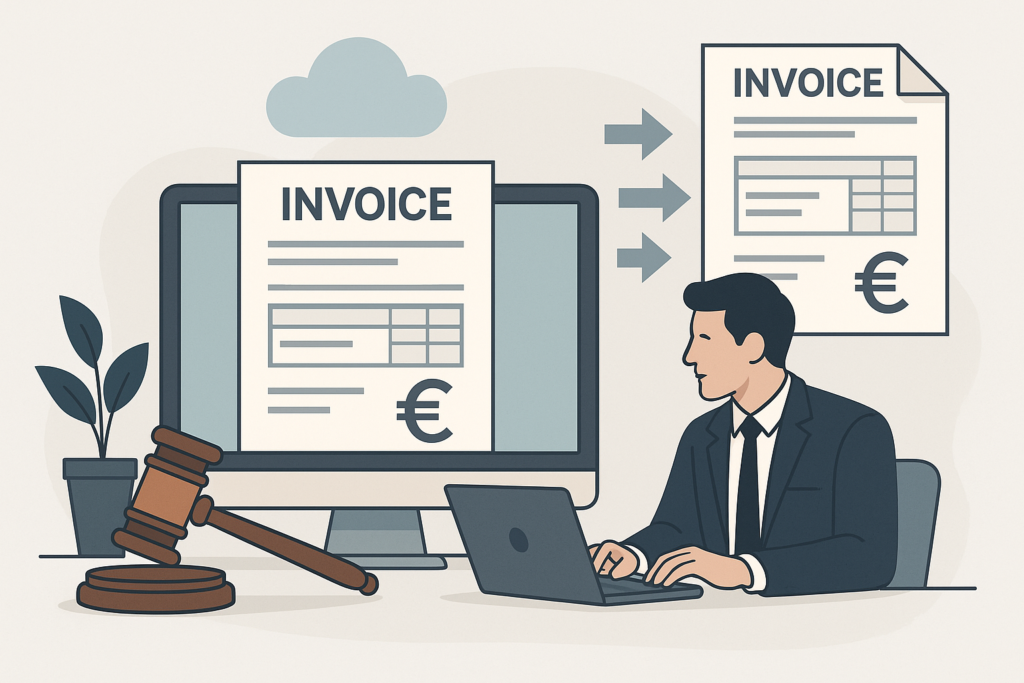
Digital transformation is transforming the way law firms do business, and invoicing is no exception. The dematerialization of invoices is gradually becoming a legal obligation and an opportunity for optimization for legal professionals. This transition to digital invoicing requires a thorough understanding of the regulatory and technical issues involved.
What is invoice dematerialization in a law firm?
Dematerialization transforms paper invoices into electronic documents with the same legal value, provided they comply with current standards. This process covers the creation, issue, transmission and storage of invoices in standardized electronic formats (signed PDF, UBL, Factur-X), guaranteeing the authenticity, integrity and legibility of documents in compliance with tax and regulatory requirements specific to the legal profession.
The regulatory framework for electronic invoicing for lawyers
Mandatory since 2020 for transactions with public entities, electronic invoicing will gradually be imposed on all French companies. The timetable foresees September 2026 for the mandatory receipt of electronic invoices, followed by their issue in 2026 for large companies and 2027 for SMEs and VSEs. This reform is part of the modernization of tax administration.
Lawyers must respect specific obligations linked to their profession. A fee agreement must be signed before any services are rendered. Electronic invoices must comply with the same legal requirements as paper invoices, while maintaining the confidentiality imposed by professional secrecy.
The Portail Public de Facturation (PPF) is the official platform for invoicing public bodies. Firms can also use certified partner dematerialization platforms to facilitate their exchanges.
The concrete benefits of dematerialization for your firm
Save time and increase operational efficiency
Dematerialization reduces invoice issuing time by 60% compared to paper format. Process automation eliminates repetitive manual data entry and the associated risk of errors, enabling lawyers to concentrate on their core business.
Lower management costs
The savings generated by dematerialization are substantial. A firm eliminates the costs of printing, envelopes, postage and physical archiving. The average cost of processing a paper invoice is 14 euros, compared with 6 euros for an electronic invoice, a reduction of 57%.
Improving customer relations
Electronic invoicing speeds up the transmission of documents to customers, with immediate receipt and faster payments. Full traceability of exchanges reinforces transparency and trust in the business relationship.
Technical solutions for law firms
Billing software selection criteria
The software must guarantee regulatory compliance and the security of sensitive data (RGPD, professional secrecy). Choose a solution that integrates time management, the different types of fees specific to lawyers and your existing accounting system. Ergonomics and ease-of-use are key to getting teams on board.
Essential features to focus on
Software designed for lawyers must automate the creation of invoices, from time management onwards, and manage the different types of fees (hourly, flat-rate, result-based). Electronic archiving with probative value, guaranteeing legal retention for a minimum of 10 years, is also an indispensable feature.
Successfully implementing dematerialization in your practice
Key deployment stages
Roll out gradually: start with public-sector customers (already mandatory since 2020), train your teams in the new tools and processes, then inform your customers of the new billing methods, highlighting the benefits.
Electronic archive management
Archiving must guarantee the integrity of invoices for at least 10 years, using a certified solution with secure backups. Choose systems that offer guarantees of longevity and storage on multiple media.
Anticipating the challenges of dematerialization
Data security and confidentiality
Professional secrecy imposes heightened security on lawyers: choose an RGPD-compliant solution with data encryption and certified hosting in France or the European Union. Establish strict access management procedures within the firm.
Supporting customers through the transition
Inform your customers in advance of the changeover, and prepare clear educational communications. Offer personalized support to customers less familiar with digital tools, to facilitate adoption.
Optimize your billing to improve your cash flow
Automated invoicing speeds up invoice issue and significantly reduces payment times. Staggered automatic reminders improve collection rates without requiring human resources. Offering modern payment methods (instant transfer, direct debit, online payment) facilitates payment and optimizes your cash flow.
Preparing for the future: towards fully digital management
The dematerialization of invoices is the first step in the overall digital transformation of your practice. Much more than a simple regulatory constraint, it represents a strategic opportunity to modernize and optimize your administrative processes.
Frequently asked questions
The dematerialization of invoices represents a major challenge for modern law firms. Find out the answers to the most frequently asked questions on this subject.
What is invoice dematerialization in a law firm?
Invoice dematerialization involves replacing paper invoices with electronic documents throughout the invoicing process. For a law firm, this means creating, sending, receiving and archiving invoices in digital format. This digital transformation has the same legal value as paper invoices, provided that current standards are respected. It optimizes administrative management and reduces document processing costs.
What are the legal requirements for dematerializing invoices for law firms?
From 2024, electronic invoicing will gradually become mandatory for all companies in France, including law firms. Invoices must guarantee authenticity of origin, integrity of content and legibility. Law firms must also ensure secure archiving for at least 10 years. Compliance with the RGPD is essential when processing customer data. It is recommended to use certified solutions that comply with the requirements of the tax authorities.
How do you set up dematerialized invoicing in a law firm?
Implementation requires several key steps: assessing the firm’s specific needs, choosing a suitable solution, training staff, and gradually migrating processes. We recommend starting with an audit of current practices, then defining a deployment plan. Team support is crucial to ensure the solution is adopted. Plan for a transition period during which the two systems coexist, to ensure business continuity.
What are the main advantages of dematerializing invoices for a law firm?
Dematerialization offers numerous benefits: it saves time on administrative processing, reduces printing and mailing costs, improves payment tracking, and reduces data entry errors. It also facilitates access to documents from anywhere, reinforces data security thanks to automatic backups, and contributes to an eco-responsible approach. Firms generally report significant improvements in productivity and cash flow.
Which tools or software should you choose to dematerialize your invoices?
Your choice should be geared towards solutions specially designed for the legal profession, integrating the specificities of lawyer invoicing. Choose certified software that complies with French regulations, and offers editing, automatic sending and secure archiving functions. Integration with your practice management software is an essential criterion. Solutions based on a legal cloud offer optimum flexibility and security. Also check the availability of responsive technical support and training tailored to legal teams.
What are the key steps to a successful transition to paperless invoicing?
For a successful transition, start by involving everyone in the firm from the outset. Set a realistic timetable and proceed in phases. Ensure the quality of your data before migration. Train your staff and appoint an internal consultant to support the changeover. Test the system on a sample basis before full deployment. Finally, plan a post-deployment follow-up to quickly identify and correct any malfunctions.
How is technology transforming invoice management in law firms?
Digital transformation is profoundly revolutionizing billing practices in law firms. Technology now makes it possible to automate many time-consuming tasks: automatic generation of invoices based on time spent, scheduled dispatch, automatic reminders for unpaid invoices, and simplified bank reconciliation. These innovations free up lawyers’ time, enabling them to concentrate on their core business, while improving customer satisfaction thanks to faster, more transparent invoicing.
Related articles
AI-generated content