
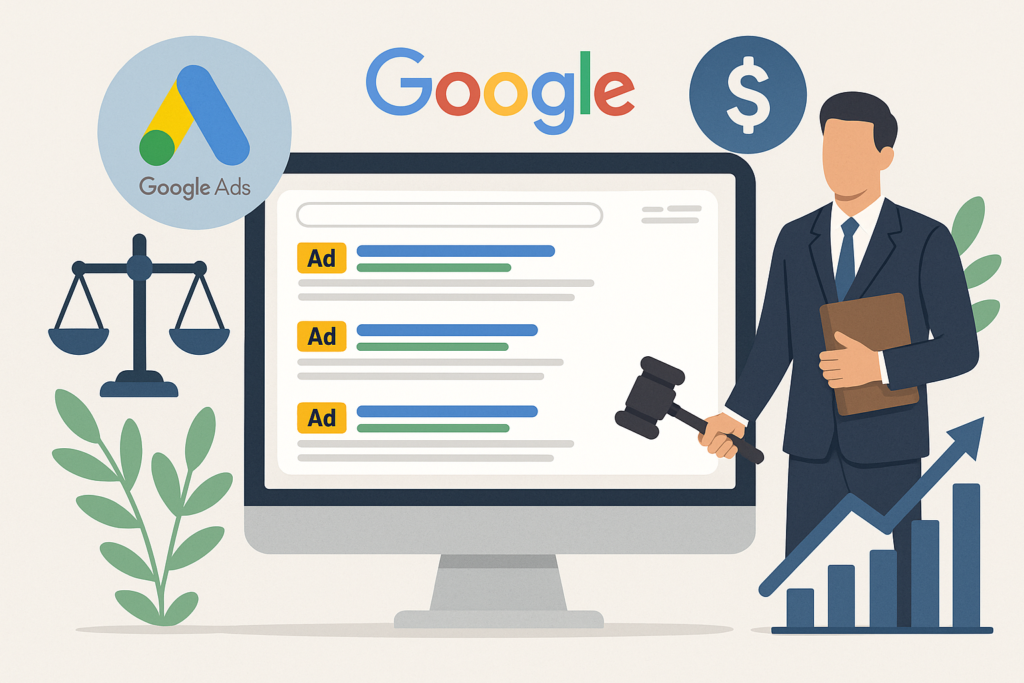
Looking to expand your legal client base quickly? Google Ads is a powerful advertising lever for law firms that want to capture qualified prospects at the very moment they’re looking for legal services. This advertising platform enables you to position your firm at the top of search results, ahead of your competitors, and generate targeted contacts in just a few days.
What is Google Ads for Lawyers?
Google Ads is Google’s advertising network that enables lawyers to display paid ads in search results. The first 3 to 4 positions displayed on Google are generally paid ads, identified by the label “Ad” or “Sponsored”. These premium positions offer maximum visibility to law firms wishing to capture the attention of prospects as soon as they search.
When a user types in a query such as “avocat droit du travail Paris” or “avocat divorce Lyon”, your ad may appear in first position depending on three determining factors: your bid (the amount you’re willing to pay per click), your Quality Score (a quality score awarded by Google based on the relevance of your ad) and the overall relevance of your landing page. In the legal sector, well-optimized ads achieve an average click-through rate of 3% to 5%.
The system works on a cost-per-click (CPC) model: you only pay when someone clicks on your ad. For lawyers, CPCs generally range from €2 to €15, depending on legal specialty and geographical area. This approach is part of a global business development strategy for your firm.
In addition to classic text ads, Google Ads offers extensions that are particularly useful for lawyers: call extensions allow prospects to contact you directly with one click (ideal for legal emergencies), location extensions display your address and facilitate visits to the firm, and teaser extensions highlight your strengths (“Free consultation”, “Available 24/7”). The platform also offers remarketing capabilities for retargeting visitors to your website, as well as the Display Network for building awareness of your practice among a wider audience.
Why lawyers should use Google Ads
Potential clients actively search for a lawyer on Google before making contact. According to legal industry statistics, 96% of people with a legal need start their search online. Without an advertising presence, you’re leaving these prospects to your competitors.
Google Ads offers three decisive advantages for your practice:
- Immediate visibility: your ads appear as soon as your campaign is activated, unlike natural referencing, which takes several months.
- Precise targeting: you reach only those people in your geographical area who are looking for your specialty.
- Budget control: you define your daily investment and can adjust your spending in real time
This approach perfectly complements other channels such as LinkedIn Ads for Lawyers, which is particularly effective for business law.
Setting up your first Google Ads campaign
Legal keyword selection
The success of your campaign depends on the strategic choice of keywords. Choose precise expressions that reflect the search intent: “avocat divorce contentieux Marseille” converts better than “avocat Marseille” for three essential reasons. Firstly, the search intent is more qualified, which attracts genuinely interested prospects. Secondly, competition is less intense on these specific keywords, reducing your cost per click. Finally, Google awards a higher Quality Score to ads that are perfectly aligned with the query, further reducing your costs while improving your positioning.
Structure your campaigns with 10 to 20 keywords per ad group to maintain thematic consistency. Use Google’s keyword planning tool to identify the terms your potential customers are searching for, giving priority to long-tail keywords such as “avocat licenciement abusif cadre Paris” or “avocat succession litigieuse Lyon”. These expressions generate less volume but convert significantly better. Master the three types of match: the exact match [avocat divorce] precisely targets this query, the expression match “avocat divorce” includes close variants, while the modified broad match +avocat +divorce captures a wider spectrum while maintaining relevance.
For local law firms, systematically integrate geolocalized keywords: your city, your arrondissement, or even your district for large metropolises. A lawyer in the 8th arrondissement of Paris will benefit from targeting “avocat droit du travail 8ème” rather than simply “avocat droit du travail Paris”, thus reducing competition and attracting a local clientele.
Systematically exclude negative keywords such as “free”, “internship”, “training”, “job”, “salary” or “study” to avoid unqualified clicks. Without this precaution, 15% to 25% of your budget can be wasted on clicks from students, job applicants or people looking for free advice. Enrich this list progressively by analyzing the search terms that trigger your ads without generating conversions.
Writing effective ads
Your ad must meet three essential criteria: relevance, differentiation and call to action. Google Ads imposes strict technical constraints: 30 characters maximum for each title and 90 characters for each description. Include your main keyword in the first title to improve your Quality Score and reduce your cost per click. Mention your legal specialty, your quantified experience (“15 years’ experience in employment law”) and include a reassuring element such as “Free initial consultation”.
Give preference to Responsive Ads (RSA), which automatically test different combinations of titles and descriptions to identify the best performing ones. Here’s an example of an effective structured ad:
- Title 1: Divorce lawyer Paris – Expert
- Title 2: 20 Years of Experience
- Title 3: Free consultation
- Description 1: Specialist in contentious and amicable divorce. Personalized support at every stage.
- Description 2: Responsive firm. Response within 24h. Transparent fees from the first appointment.
Systematically create 3 to 5 ad variants per group to identify the most effective formulations. In the legal sector, a well-optimized ad generally achieves a click-through rate of between 4% and 6%. Regular A/B testing allows you to gradually improve your performance and significantly reduce your cost per acquisition over time.
Destination Page Optimization
The user who clicks on your ad should arrive on a dedicated landing page, not on your general home page. This consistency between ad and landing page, known as “message match”, not only improves your Google Ads Quality Score and reduces your costs per click, but above all increases your conversion rate by 30% to 50%.
Your landing page should use exactly the same terms as your ad: if you promise “Avocat divorce contentieux Lyon”, this title should appear in H1 on your page. This continuity reassures visitors that they’ve come to the right place.
An effective landing page for lawyers must contain these essential elements:
- A clear title stating the request and your legal specialty
- A contact form visible from the first screen, with up to 3-4 fields (name, email, phone, message)
- A clickable telephone number at the top of the page, enabling direct calls from cell phones
- Authentic customer testimonials with first name and initial for credibility
- Your certifications and bar registrations, recognized specializations
- Reassurance: years of experience, number of cases handled, success rate if ethically acceptable
- A call-to-action repeated at least three times on the page (top, middle, bottom)
A professional website with optimized landing pages increases your conversion rate by 8% to 15% on average, compared with 2% to 4% for a generic landing page.
Technical performance is just as crucial: your page must load in less than 3 seconds, bearing in mind that each additional second reduces your conversion rate by 7%. With 65% of lawyer searches carried out on mobile, your landing page must be perfectly responsive, with call buttons and forms that are easy to use on a small screen.
Budget and Return on Investment
A law firm needs a minimum monthly budget of €500 to €1,000 to achieve significant results. To obtain statistically useful data, you need to generate at least 50 to 100 clicks before you can effectively optimize your campaigns. With an average CPC of €5 and a conversion rate of 10%, you’ll get around 10 to 20 qualified contact requests per month once your campaign has been optimized.
Anticipate an initial learning phase of 1 to 3 months, during which your return on investment will be limited or even negative. This period allows the Google algorithm to understand which ads and keywords generate the best conversions for your practice. The performance figures presented in this article correspond to campaigns optimized after several months of fine-tuning, not to immediate results.
Once your campaign has stabilized, with a contact-to-customer conversion rate of 30% and an average fee per case of €2,000, your return on investment can gradually reach 200% to 300% after 4 to 6 months of continuous optimization. To calculate your real ROI, consider customer lifetime value: a satisfied customer often generates several files and referrals over several years, multiplying the profitability of your initial advertising investment. These figures vary according to your specialty: business law generally generates higher fees than family law.
| Specialty | Average CPC | Conversion rate |
|---|---|---|
| Employment law | 4€ – 8€ | 8% – 12% |
| Family law | 3€ – 6€ | 10% – 15% |
| Business law | 8€ – 15€ | 5% – 8% |
| Criminal law | 5€ – 10€ | 7% – 10% |
Take seasonality into account in your budget planning: family law sees peaks in demand after the holiday season, while employment law sees an increase in searches in September and January. Adapt your monthly budgets to these variations to maximize your profitability.
Ethical Compliance and Good Practices
Your Google Ads must respect the ethical rules of the legal profession. Avoid promises of results (“Win your case”), comparisons with other lawyers or overly aggressive pricing. Instead, communicate factually about your expertise and experience.
Always mention your registration with the bar and your recognized areas of specialization. This transparency reinforces your credibility and naturally filters out irrelevant requests.
Measure and Optimize Your Performance
Install Google Ads conversion tracking to measure precisely how many clicks generate qualified contacts. This tracking system should include call tracking, as many potential customers prefer to call your practice directly rather than fill in an online form.
Analyze your data at least once a week for the first three months, then monthly once your campaigns have stabilized. Focus on these essential KPIs:
- CTR (click-through rate): indicates the relevance of your ads (aim for a minimum of 5%)
- Quality Score: Google quality score to be maintained at 7/10 or higher to remain competitive
- Conversion rate: percentage of clicks converted into contacts
- Cost per conversion: investment required to obtain a qualified contact
- Impression rate: how often your ads are displayed in relation to total searches
Connect Google Analytics to your Google Ads account to analyze visitor behavior on your site: page views, visit duration, bounce rate. This data reveals whether your landing page is meeting the expectations created by your ad.
Adjust your bids according to performance: increase them on profitable keywords and reduce them on those that generate clicks without conversions. This continuous optimization can reduce your cost per acquisition by 20% to 50%, depending on your starting point and the rigor of your adjustments.
Integrating Google Ads into your digital strategy, combined with approaches such as GEO optimization, positions you sustainably against the competition and ensures a steady flow of new customers for your practice.
Common mistakes to avoid in Google Ads for Lawyers
When launching your first Google Ads campaign, it’s crucial to avoid some common mistakes that can drastically affect your results. Failing to use negative keywords from the outset can result in a 20-30% loss of budget, as unqualified clicks eat into your resources. What’s more, directing traffic to your home page instead of a dedicated landing page can halve or even triple your conversion rate. Make sure you alsoactivate conversion tracking to accurately measure your ROI and optimize your campaign.
Mistakes continue to be made with the single, unchecked use of wide matching, which leads to many unqualified clicks. Pay particular attention to adapting your ads for mobile, as 65% of searches take place there. Neglecting ad extensions can also reduce your CTR by 10-15%. Avoiding these classic pitfalls from the outset will enable you to optimize your budget effectively and maximize your results.
Frequently asked questions
Thinking of using Google Ads to grow your law firm? Find out the answers to the most frequently asked questions about digital advertising strategies for legal professionals.
What is Google Ads for lawyers?
Google Ads for Lawyers is an online advertising platform that enables law firms to display targeted ads in Google search results. This solution enables lawyers to appear at the top of results when potential clients search for specific legal services. The system works on a cost-per-click (CPC) model, where you only pay when a user clicks on your ad. It’s a particularly effective tool for generating qualified leads and rapidly increasing a law firm’s visibility.
How much does Google Ads cost for a law firm?
The cost of Google Ads for a law firm varies considerably according to specialization and local competition. On average, the cost per click in the legal sector is between €5 and €50, with highly competitive areas such as business law or criminal law reaching €100 per click. A minimum monthly budget of €1,000 to €3,000 is generally recommended to achieve measurable results. Return on investment depends on your conversion rate and the average value of a customer to your firm.
What are Google Ads best practices in the legal sector?
Best practices include: creating campaigns targeted by legal specialization, using long-tail keywords to reduce costs, writing ads that comply with bar ethics rules, optimizing landing pages with clear calls to action, using ad extensions to display contact details and customer reviews, precise geographic targeting for local firms, and implementing rigorous conversion tracking. It’s also essential to exclude irrelevant search terms and regularly adjust bids according to performance.
How to optimize a Google Ads campaign for lawyers
Optimizing a Google Ads campaign for lawyers involves a number of ongoing actions: regularly analyzing search terms and adding negative keywords, testing different ad variants to improve click-through rates, adjusting bids according to best-performing days and times, improving quality score by aligning ads and landing pages, using remarketing to re-engage visitors, segmenting campaigns by type of legal service, and precisely tracking conversions through to qualified appointments or contacts.
What are the advertising regulations for lawyers on Google Ads?
Lawyers must adhere strictly to the ethical rules of their bar association when using Google Ads. In France, advertising must be dignified, fair and transparent. It is forbidden to make comparisons with colleagues, to guarantee results, to use aggressive canvassing, or to mention fees without clear details. Advertisements must state the exact professional title and the bar association. All advertising must give priority to objective information on skills, and must not be misleading or likely to mislead the public.
What tools should you use to manage your legal Google Ads campaigns?
To effectively manage your Google Ads campaigns, several tools are essential: Google Ads Editor for mass campaign management, Google Analytics to analyze visitor behavior, phone call tracking tools like CallRail, lead management platforms to qualify contacts, and management software for lawyers that centralizes marketing and customer data. Integrating a legal CRM enables you to measure ROI precisely, tracking each lead from advertisement to conversion into a paying customer, thus optimizing your advertising investments.
Related articles
AI-generated content