
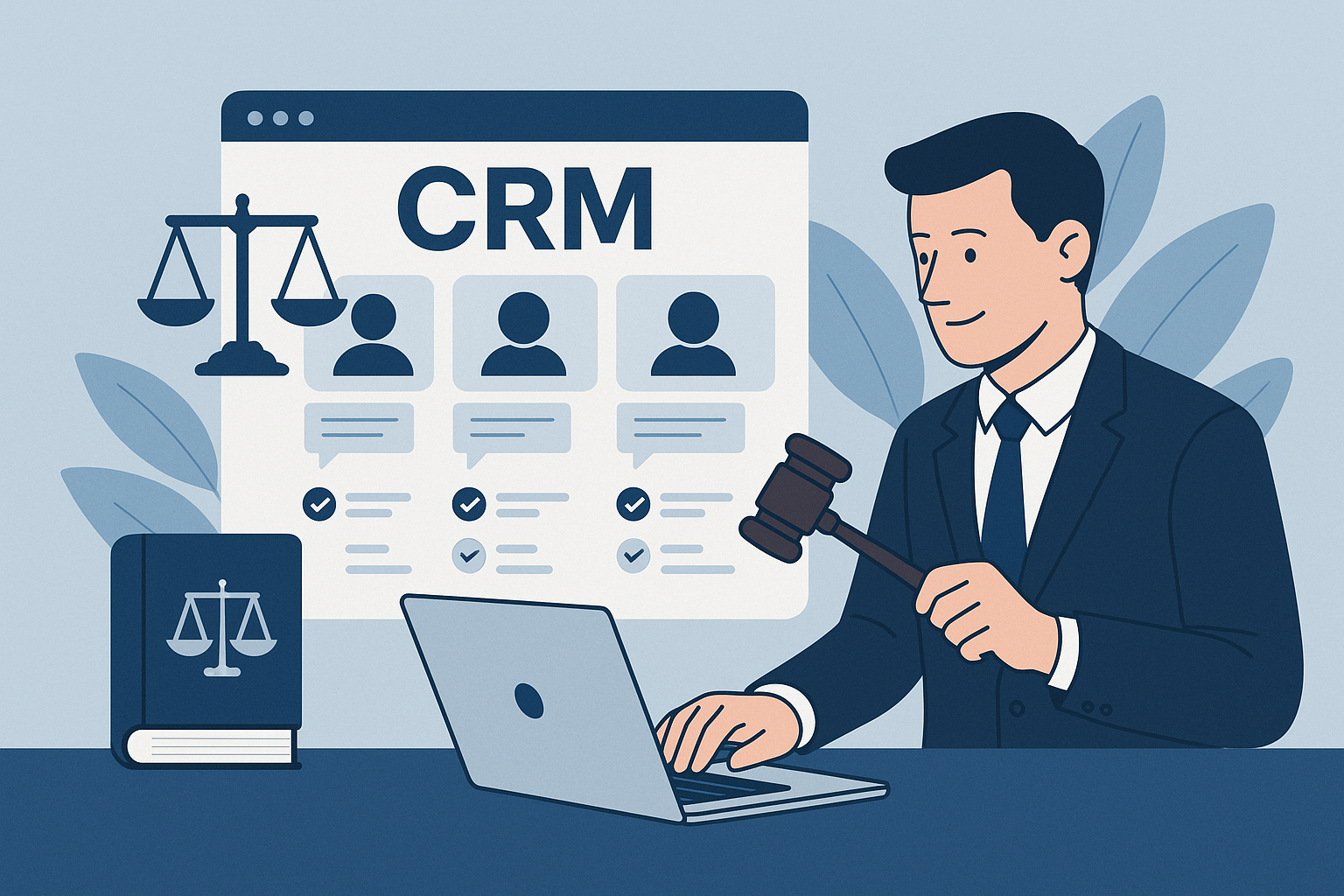
CRM Avocat: Optimize the management of your legal clientele
Effective customer relationship management represents a major challenge for modern law firms. The right lawyer CRM transforms this complexity into a competitive advantage, by centralizing customer information, automating repetitive tasks and improving the quality of legal service. Find out how this tool is becoming indispensable for structuring your practice and developing your firm.
What is a lawyer CRM?
A lawyer CRM (Customer Relationship Management) is software specially designed to manage all interactions with your customers and prospects. Unlike general CRMs, it integrates the specific features of the legal profession: case tracking, deadline management, reinforced confidentiality and ethical compliance. This solution centralizes all customer data in a single interface, giving you instant access to the complete history of exchanges, associated documents and financial information. The integrated lawyer dashboard gives you an overview of your business in real time.
The tool meets the traceability and security requirements specific to the legal profession, with enhanceddigital authentication protocols and encryption of sensitive data. This secure infrastructure guarantees the protection of professional secrecy and compliance with the ethical obligations of the legal profession.
The essential features of a CRM for lawyers
Centralization of customer information
CRM brings together all the data relating to each customer: full contact details, consultation history, documents exchanged and appointment notes. This centralization eliminates the dispersal of information between different media, and considerably reduces the risk of errors.
You can instantly consult a customer’s complete profile before an appointment or hearing. This optimal preparation enhances the quality of your advice and customer satisfaction. Searching for information becomes instantaneous thanks to advanced filtering functions.
Automation of administrative tasks
Automation is one of the major benefits of a lawyer CRM. The system automatically generates due date reminders, sends appointment confirmations and triggers payment reminders according to predefined rules.
This automation frees up valuable time that you can devote to high value-added activities. Repetitive tasks such as automatic time entry or sending follow-up emails are carried out without manual intervention. Your productivity increases by 30 to 40% according to industry studies.
Sales follow-up and business development
CRM transforms your sales approach by structuring prospect follow-up. You can quickly identify high-potential opportunities and prioritize your development actions. The system records every interaction and automatically calculates conversion rates.
Detailed statistics reveal your most effective acquisition sources. You adjust your marketing strategy based on objective data rather than subjective impressions. This data-driven approach optimizes your return on sales investment.
Centralization of customer information
CRM brings together all the data relating to each customer: full contact details, consultation history, documents exchanged and appointment notes. This centralization eliminates the dispersal of information between different media, and considerably reduces the risk of errors.
You can instantly consult a customer’s complete profile before an appointment or hearing. This optimal preparation enhances the quality of your advice and customer satisfaction. Searching for information becomes instantaneous thanks to advanced filtering functions.
Automation of administrative tasks
Automation is one of the major benefits of a lawyer CRM. The system automatically generates due date reminders, sends appointment confirmations and triggers payment reminders according to predefined rules.
This frees up your time for high value-added activities. Repetitive tasks such as data entry or sending follow-up e-mails are carried out without manual intervention, significantly improving your daily productivity.
Sales follow-up and business development
CRM transforms your sales approach by structuring prospect follow-up. You can quickly identify high-potential opportunities and prioritize your development actions. The system records every interaction and automatically calculates conversion rates.
Detailed statistics reveal your most effective acquisition sources. You adjust your marketing strategy based on objective data rather than subjective impressions. This data-driven approach optimizes your return on sales investment.
Integration with practice management tools
A high-performance lawyer CRM integrates seamlessly with your other professional tools. Connection with your case management system eliminates duplicate data entry and ensures consistency of information. This interoperability transforms your CRM into a veritable central hub for your legal activity.
Integration with your software ecosystem multiplies efficiency gains. Invoicing tools automate invoice generation as soon as a file is closed, reducing collection times and improving your cash flow. Synchronization with your electronic calendar ensures a unified view of your appointments: every event created in CRM appears instantly in your calendar, and vice versa. This automatic synchronization eliminates calendar conflicts and saves you several hours a week by avoiding re-entries and manual checks.
Customer data security and compliance
Confidentiality is an absolute must in the legal profession. An appropriate CRM incorporates enhanced security protocols (encryption, multi-factor authentication, traceability) to guarantee the protection of sensitive information. This technical infrastructure preserves professional secrecy and protects your customers against any data breach.
RGPD compliance is becoming an unavoidable legal requirement. Your CRM must enable the management of consents, the exercise of the right to be forgotten and data portability, while ensuring automatic backups and certified hosting that guarantee the permanent availability of your critical information. This dual approach to security and compliance ensures business continuity in all circumstances.
Choosing the right CRM for your law firm
Priority selection criteria
First, identify your specific needs: conflict of interest management, prescription tracking, customized reporting. Ease of use then largely determines the rate of adoption by your team. An intuitive interface reduces training time and accelerates learning. Choose solutions offering a free trial period to test ergonomics and functionalities in real-life conditions.
Evaluate the total cost, including subscription, training and maintenance. Compare offers on an annual basis to accurately measure the investment. Cloud solutions generally offer better value for money than local server installations.
Solutions for different practice sizes
For self-employed lawyers, freeware is often a sufficient starting point before upgrading to a more comprehensive pay-as-you-go solution. Medium-sized firms tend to opt for collaborative functionalities with granular access rights and detailed history, essential for overall firm management. Larger firms, on the other hand, prefer enterprise solutions with open APIs, extensive integration capabilities and dedicated technical support for in-depth customization.
Maximize the return on your CRM investment
The successful deployment of a lawyer CRM begins with the involvement of your team right from the selection phase. This involvement encourages buy-in and facilitates the appropriation of the tool. Provide appropriate initial training and ongoing support to ensure effective adoption by all users. This structured change management directly determines the success of your investment.
Measure the impact of CRM with precise performance indicators: prospect transformation rate, average file processing time or level of customer satisfaction. The effectiveness of CRM depends on rigorous data entry by the entire team. Establish clear rules for entering customer data and updating status. This collective discipline guarantees the reliability of information and the relevance of analyses for steering your business.
Transform your customer relations with the right CRM
The adoption of a lawyer CRM represents much more than a simple technological investment: this tool structures your organization, professionalizes your sales approach and significantly improves customer satisfaction. The digitization of customer relations has become a standard in the legal profession, and firms equipped with a CRM are generally seeing a significant improvement in their sales performance and profitability. In the face of growing customer expectations in terms of responsiveness, transparency and accessibility, a high-performance CRM is becoming an indispensable ally for your law firm. Evaluate the available solutions now to identify the one that precisely matches your needs.
Frequently asked questions
Find out the answers to the most frequently asked questions about CRM for lawyers and optimizing the management of your legal clientele.
What is a CRM for lawyers?
A CRM (Customer Relationship Management) for lawyers is software specifically designed to manage a law firm’s customer relationships. It centralizes all client information, files, interactions, appointments and documents in a single platform. This type of tool enables lawyers to track each client’s complete history, automate administrative tasks, manage deadlines and improve communication. A legal CRM also facilitates collaboration between firm members and ensures better organization of day-to-day work.
What are the best CRMs for lawyers and law firms?
The best CRMs for lawyers include Clio, which offers a complete practice management solution, Lexoffice for its ease of use, and HubSpot with its version tailored to the legal profession. Salesforce also offers advanced, customizable features for large firms. These solutions are distinguished by their specific features for the legal sector: case management, billable time tracking, integration with billing tools, and compliance with confidentiality obligations. The choice depends on the size of your practice, your budget and your specific needs.
How much does a CRM for lawyers cost?
The price of a CRM for lawyers varies considerably according to functionality and the size of the firm. Entry-level solutions start from €30 per user per month, while professional solutions range from €60 to €150 per user per month. Larger firms often opt for customized enterprise solutions, which can cost in excess of €200 per user. Some publishers offer sliding-scale rates according to the number of users. It’s important to factor in ancillary costs such as training, implementation and technical support into your overall budget. To estimate your costs accurately, you can use a fee simulator tailored to your business.
Are there any free CRMs for law firms?
Yes, several free CRMs are available to law firms. HubSpot CRM offers a free version with basic functionality sufficient for small firms. Zoho CRM also offers a free plan for up to 3 users. Bitrix24 lets you manage up to 12 users free of charge. However, these free versions have significant limitations: restricted number of contacts, lack of advanced features, limited storage and reduced customer support. For optimal professional use, we recommend migrating to a paid version as your practice grows.
How to optimize legal client management with a CRM?
To optimize legal client management with a CRM, start by centralizing all client and file data in the system. Automate repetitive tasks such as deadline reminders, reminders and appointment confirmations. Use segmentation features to personalize your communications according to customer or file type. Use reports and dashboards to analyze your performance and identify opportunities for improvement. Ensure that everyone in the firm uses CRM consistently, and train your team regularly in new features.
What are the best practices for using CRM in a law firm?
Best practice starts with defining clear processes for data entry and updating. Ensure that all customer interactions are systematically recorded in CRM. Establish appropriate access rights to protect the confidentiality of sensitive files. Integrate your CRM with your other business tools, such as billing software and e-mail. Clean up your database regularly to eliminate duplicates and obsolete information. Finally, take advantage of analysis features to measure the effectiveness of your customer management and adjust your strategies.
How do you ensure the security of customer data in a legal CRM?
Customer data security is paramount for any law firm using a CRM. Choose a solution that offers end-to-end encryption and RGPD-compliant secure servers. Implement two-factor authentication for all users and define robust password policies. The security of electronic transactions must be guaranteed, especially when exchanging sensitive documents. Make regular back-ups and test your data recovery procedures. Make your team aware of good cybersecurity practices to prevent the risk of confidential information leaking out.