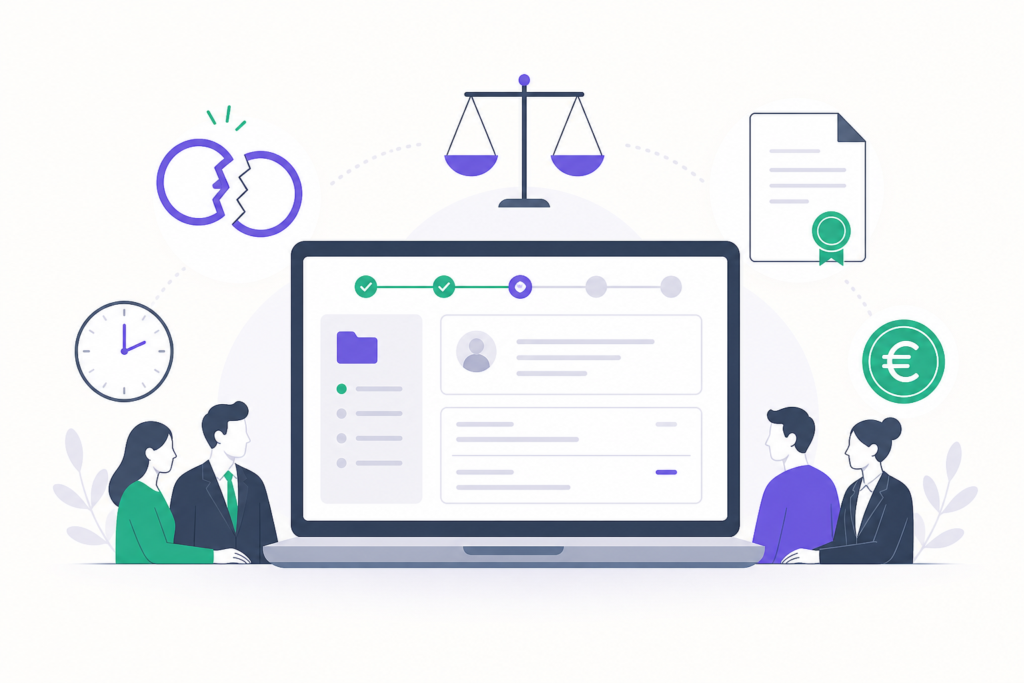
With the rapid evolution of technology, the digitization of contract law is becoming increasingly important, changing the way agreements are created, managed and enforced. In this article, we explore this digital metamorphosis of the legal field.
What is the Digitalization of Contract Law?
The digitization of contract law refers to the use of digital technologies to facilitate, execute and manage legal contracts. This digital transformation includes all aspects of a contract’s lifecycle, from creation to conclusion, including archiving and change management.
The Impact of Technology on Contracts
The use of digital tools such as electronic signatures and legal bidding platforms, as well as innovations such as smart contract and blockchain, are revolutionizing contract procedures.
The Electronic Signature
Electronic signatures greatly simplify remote transactions, but their legal scope must be understood precisely. Under European Union law, Article 25 of Regulation (EU) No. 910/2014 (eIDAS) provides that an electronic signature may not be rejected solely on the grounds that it is in electronic form or that it does not meet the requirements for a qualified electronic signature (Art. 25, § 1), and that only a qualified electronic signature has legal effect equivalent to that of a handwritten signature (Art. 25, § 2). Under French law, Article 1366 of the Civil Code grants electronic documents the same probative value as paper documents, provided that the author can be identified and the document’s integrity is guaranteed, whereas Article 1367 requires that an electronic signature be based on a reliable identification process, the reliability of which is presumed until proven otherwise when the conditions set forth by decree of the Council of State are met (eIDAS Regulation 910/2014 and Articles 1366 and 1367 of the Civil Code).
Smart Contracts and Blockchain
Smart contracts automate contract execution using computer code, and the blockchain provides a secure environment for storing and exchanging these dematerialized contracts.
Benefits of digitization for legal professionals
The transition to digitalization offers legal professionals considerable advantages, such as access to premium legal software, increased efficiency through theautomation of legal processes, and data security.
Premium Legal Software
Premium legal software provides integrated platforms for managing contracts, from drafting to monitoring clauses and deadlines.
Automation and efficiency
Automation reduces human error and speeds up the management of legal documents, which is essential for practitioners managing a high volume of contracts.
Challenges of Contract Digitization
However, digitalization also raises challenges, particularly on issues of legal cybersecurity and legal compliance, such as that relating to the RGPD.
Security & Privacy
The risk of cyber-attacks calls for robust solutions to protect the sensitive data contained in digital contracts.
Legal Compliance
Compliance with ever-changing regulations, such as data protection standards, remains a central concern.
Frequently asked questions
Here is a list of frequently asked questions about the digitization of contract law.
Is an electronic signature legally valid?
Yes. Under European Union law, Article 25 of the eIDAS Regulation (EU) No. 910/2014 prohibits the rejection of an electronic signature solely on the grounds of its electronic form (Art. 25, § 1), and only a qualified electronic signature is equivalent to a handwritten signature (Art. 25, § 2). Under French law, Article 1367 of the Civil Code requires a reliable identification method, the reliability of which is presumed when the conditions set forth by decree of the Council of State are met (Article 1367 of the Civil Code and the eIDAS Regulation 910/2014).
What is a smart contract?
A smart contract is an agreement in digital form that is automatically executed when predefined conditions are met.
Can digitalization reduce contract costs?
Absolutely, it can cut costs in terms of management and storage time, as well as reducing the potential for human error.
Note: In today’s legal practice, digitization is helping to refine contractual processes, while raising issues of training and adaptation to new tools. This balancing act between innovation and tradition continues to shape the complex landscape of contract law in the digital age.