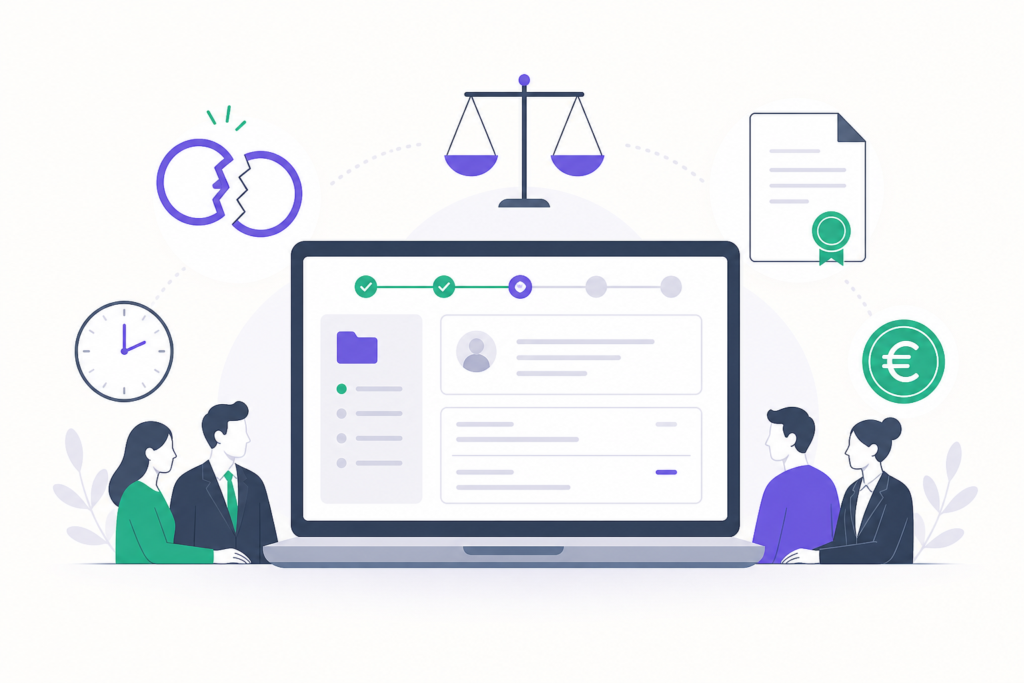
In the digital age, the legal sector is undergoing a revolution with the emergence of legal crowdsourcing. This practice involves soliciting contributions from a large number of people, usually online, to gather information, ideas or solve complex legal problems. In this article, we explore the contours and challenges of this collaborative approach.
What is legal crowdsourcing?
Legal crowdsourcing refers to voluntary collective participation in legal projects by a community of individuals, whether legal experts or ordinary citizens. This method relies on collective intelligence to carry out tasks such as researching case law, drafting contracts or analyzing legislation. It represents a significant innovation, particularly in the context of legal design, which aims to make the law more accessible and comprehensible to all.
History and development
Historically, crowdsourcing in law has its roots in initiatives such as public commentary on draft legislation. Today, it manifests itself in a variety of forms, including online platforms that organize massive contribution projects for legal purposes. Predictive justice and theuse of blockchain in the legal sector are relevant examples of the technological evolution favoring crowdsourcing.
The benefits of crowdsourcing
The benefits of crowdsourcing for the legal sector are manifold. It not only optimizes costs and saves considerable time, but also ensures greater precision in the work carried out, thanks to the diversity of contributors. Legal analysis, for example, is enriched by multiple perspectives, increasing the quality of insights.
Challenges and limits
Legal crowdsourcing is not without its challenges, however. Issues related to data privacy, the consistency of contributions, and recognition of participants’ work are significant concerns. Furthermore, alignment with existing legal systems—such as GDPR compliance or governance, risk, and compliance (GRC) practices —remains crucial. In particular, when a law firm or platform entrusts a service provider with the processing of personal data on its behalf, the CNIL requires that this processor provide sufficient safeguards and that a contract be entered into, specifying, in particular, the allocation of responsibilities regarding confidentiality, user authentication requirements, the conditions for data return and destruction, as well as incident notification rules; Measures to verify these safeguards, such as security audits, must also be provided for (source: CNIL, “Security: Managing Outsourcing,” page updated on March 14, 2024). The exact legal classification of crowdsourcing contributors—and the specific use case of each project—must therefore be analyzed on a case-by-case basis to determine whether this framework applies.
Practical applications
The areas of application of crowdsourcing in law are vast. Examples include the development of online dispute resolution platforms, where users contribute to the resolution of concrete cases, or legal cybersecurity, which takes advantage of this modus operandi to reinforce the security of legal data.
Contributions to legislation and case law
Legal crowdsourcing also plays a role in the development of legislation and the analysis of case law, where the general public can participate in open debates or contribute to the creation of a comprehensive legal database. This contributes to greater democratization of the law and the emergence of new forms of predictive justice.
The role of emerging technologies
Emerging technologies such as AI, represented in particular by automatic natural language processing algorithms, play a facilitating role in legal crowdsourcing. In fact, they make it possible to collect and analyze participants’ contributions more efficiently.
Frequently asked questions
Here is a list of frequently asked questions to help you understand the concept of legal crowdsourcing.
Can crowdsourcing replace professional lawyers?
No, crowdsourcing is not intended to replace legal professionals, but rather to complement their expertise by leveraging the collective knowledge and specialized skills available in the crowd.
How can we ensure the quality of contributions in legal crowdsourcing?
Quality assurance is based on verification and moderation mechanisms, where legal experts can validate and correct information submitted by the community.
What impact does crowdsourcing have on the accessibility of legal information?
Crowdsourcing has a positive impact on the accessibility of legal information, making it more open and available to a wide audience, thus promoting legal education and transparency.
Can legal crowdsourcing be considered a reliable source of legal information?
The reliability of crowdsourcing platforms depends heavily on expert verification and validation processes: the more rigorous and well-documented these checks are, the more reliable the information produced can be. However, this does not, in and of itself, guarantee a level of reliability equivalent to that of official legal sources or consultation with a legal professional, which must remain the standard for legally binding matters.
What are the guarantees of confidentiality in legal crowdsourcing?
Privacy guarantees depend on the data protection policies and measures adopted by crowdsourcing platforms, such as compliance with the RGPD and cybersecurity standards.
Legal crowdsourcing is clearly part of a dynamic of innovation and transformation in the legal sector. It embodies the convergence of law, technology and mass collaboration, and is set to play an increasingly significant role in the way legal services are conceived, shared and experienced.