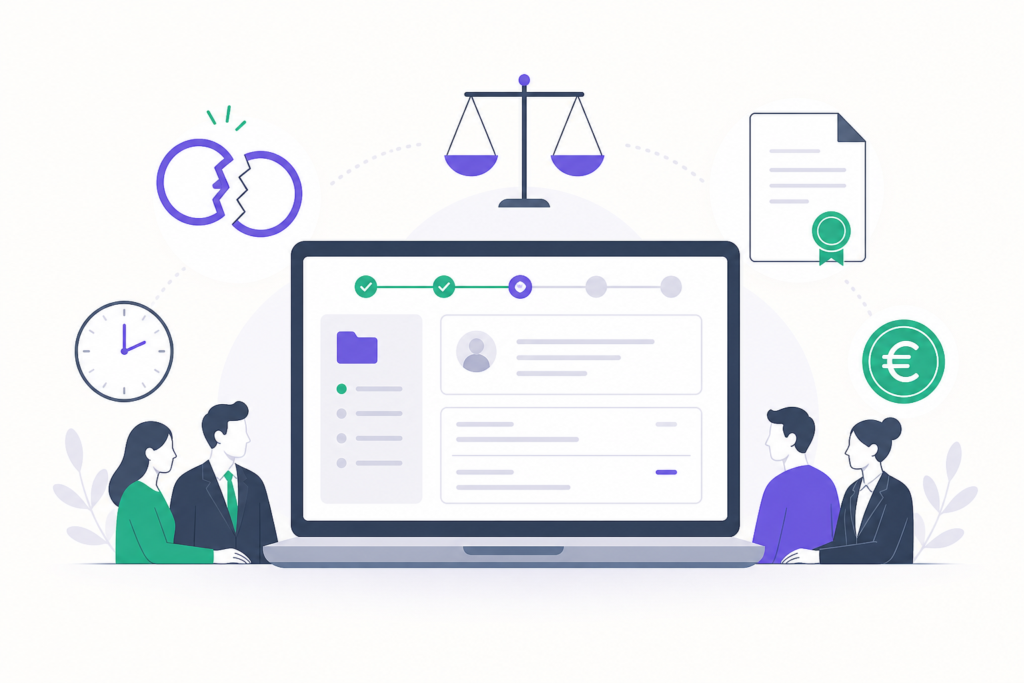
At a time when digital technology is taking hold in all sectors, the world of justice is also undergoing a transformation. Time optimization, cost reduction, easier access to justice: the automation of legal processes is becoming a major challenge for the legal profession. How is this revolution taking place? What tools are at the forefront of this change? Here’s how it works.
What is Judicial Process Automation?
Judicial process automation refers to the use of technology to simplify and accelerate repetitive tasks within the judicial domain. Thanks to dedicated software and applications, premium legal software, artificial intelligence and machine learning, legal professionals can focus on the more strategic aspects of their work, by delegating documentation, data collection or case follow-up to automated systems.
Impact on law firms and institutions
The integration of automation is transforming the day-to-day management of law firms and other legal institutions. Tasks such as scheduling hearings, researching case law and editing legal documents can now be automated. This reduces human error and improves efficiency.
In the public sector, certain forms of automated processing are subject to specific regulations. As a historical example,Article 1 of the decree of September 25, 1996, concerning the automated management of legal aid cases, authorized the implementation of an automated case management system for the courts. This authorization, which applies specifically to a particular type of data processing, does not constitute a general authorization for all judicial automation tools.
Advantages in Customer Relations
In addition to the organizational aspect, customers benefit directly from this modernization. With tools such as the online dispute resolution platform, litigants have easier access to the law and faster resolution of their cases.
Improved prediction and analysis
The predictive aspect is another facet of the automation of judicial processes. Systems such as those based on the concept of predictive justice enable in-depth analysis of previous decisions to help anticipate possible outcomes in litigation.
Innovative tools
Among the most popular solutions are legal project management platforms, which track cases and deadlines. Speech recognition and automatic transcription systems make it easy to write up reports and minutes.
Artificial intelligence in the service of the law
The beating heart of the digital revolution, artificial intelligence (AI) is increasingly used to automate case law research, contract analysis or even to design smart contracts.
Blockchain and Exchange Security
Thanks to its tamper-proof structure, blockchain promises to make the exchange of legal information even more secure. This device is particularly relevant for evidence management or authentication of legal documents.
Frequently asked questions
Here is a list of frequently asked questions about Automated Court Processes.
Is the use of automation safe from a legal and safety point of view?
Automation technologies applied to the judicial field are designed to comply with current legal standards. They incorporate mechanisms to ensure the confidentiality and security of processed data. Moreover, platforms that respect RGPD compliance standards reinforce this reliability.
Can automation replace lawyers?
No, automation is intended to be a tool for assisting and empowering legal professionals. It allows repetitive, time-consuming tasks to be delegated, leaving lawyers more time for the more complex, strategic aspects of their work.
How can we measure the effectiveness of automating judicial processes?
The effectiveness of automation is measured in terms of reduced processing times, fewer errors, and improved customer satisfaction. Legal analytics tools can also be used to monitor results and adjust processes if necessary.